•Vasileios Balntas
Staer Warehouses: An Open Dataset for Physical AI Research
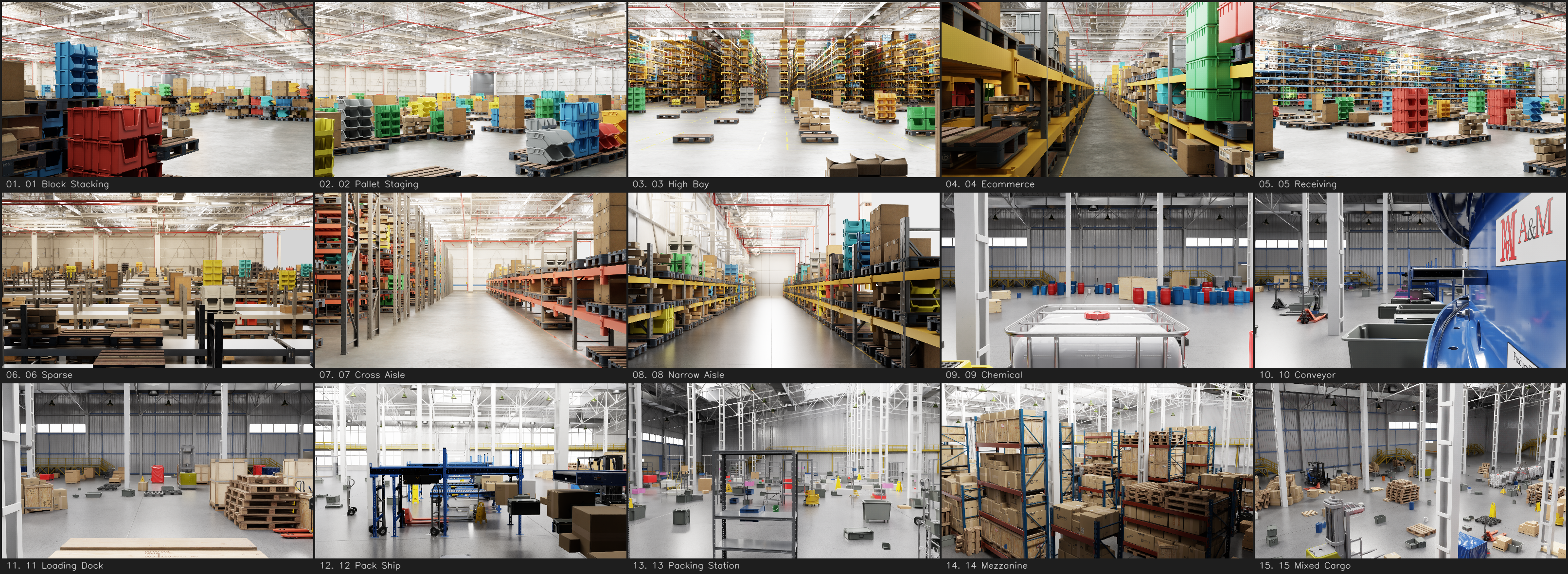
The 15 warehouse environments included in Staer Warehouses v0.1, from open staging areas to dense high-bay racking.
Stay updated with the latest news, announcements, and insights from Staer.
The 15 warehouse environments included in Staer Warehouses v0.1, from open staging areas to dense high-bay racking.
In the spring of 2025, a logistics director at a large Nordic retailer did something that would have seemed odd to anyone watching. He pulled out his phone, opened a stopwatch, and followed one of his warehouse workers around for an entire shift.
The worker's name doesn't matter. What matters is what the logistics director counted: fourteen times that day, the worker left what he was doing to go look for something. A pallet that had arrived but hadn't been racked. A shipment that the system said was in aisle 12 but wasn't. A product that a customer needed and nobody could locate without walking the floor.
Staer joins an distinguished list of Nav2 Sponsors committing to the long-term development and maintenance of the industry standard framework. Staer is building the physical AI platform for robust, efficient, and safe fleet coordination for autonomous mobile robots (AMRs). The partnership with Open Navigation seeks to unlock the potential for high-fidelity navigation across diverse environments including homes, warehouses, agricultural fields, and more.
 Preview of 3D semantic map integration in Nav2
When Amazon announced their one-millionth robot deployment this summer, it seemed like a watershed moment. But Amazon is the exception, not the rule. Most logistics operations don't look anything like Amazon's hyper-structured environments.
At Staer, we build intelligence for mobile robot fleets operating in the reality most enterprises face: messy operations, ad hoc processes, and under-instrumented facilities. Recently, I joined Søren Halskov Nissen from Yaak and Sam Baker from Planet A for a panel at The Drop, where we unpacked hard truths about mobile robotics. Several persistent myths aren't just wrong—they're actively holding our industry back.